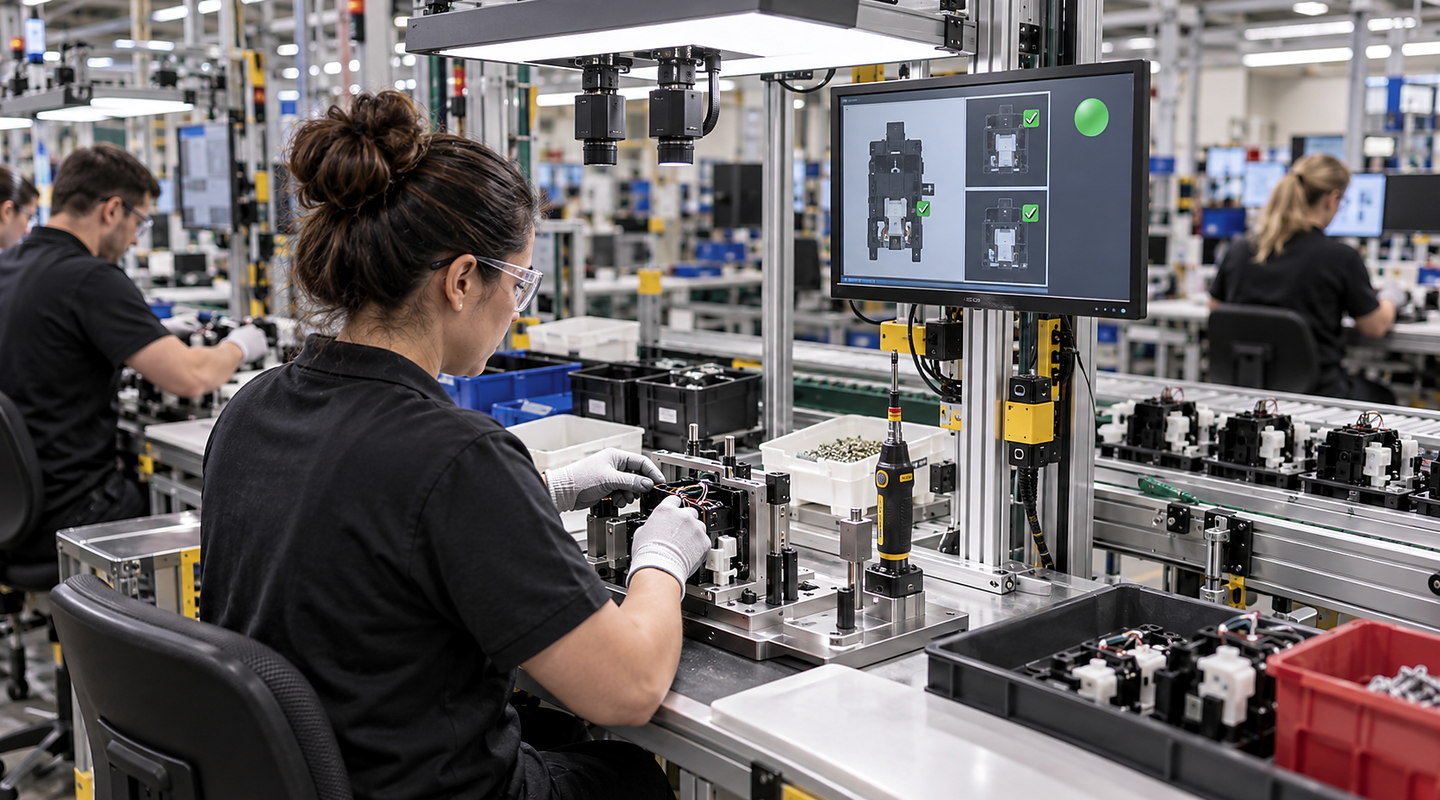
Missing component inspection for production assemblies
Missing-component inspection checks visible evidence that required parts are present at a defined assembly stage. List each component and product variant before choosing a camera arrangement; a presence result must be kept distinct from position, identity and hidden functional checks.
Speak directly with Oxford Vision Systems about presence verification of required assembly components.
Quick answer
How can a vision system check that all required components are present?
Define each component and its expected location for every product variant. Supply complete assemblies and examples with a missing, wrong or displaced part. Check that the relevant features are visible at the inspection stage, then agree recipe selection, borderline results and the action taken before the assembly proceeds.
Use these decisions to define the proposed equipment and the checks needed for your application.
Decision 1
One decision feature per component
For each required part, identify the surface, edge, opening or other visible feature that will prove presence. Record where it appears in the image. If another part later hides it, consider inspection earlier in the assembly sequence.
Decision 2
Separate product variants
Create a matrix showing which components are required, optional or absent by design for each variant. Define how the correct recipe is selected and confirmed. Otherwise a legitimate empty location can be confused with a missing part.
Decision 3
Include realistic failure samples
Provide complete assemblies and examples with each relevant component missing, displaced or incorrect. Include near-limit conditions and normal supplier variation. A single perfect assembly and an obviously empty fixture do not represent the full decision boundary.
Decision 4
Control presentation and occlusion
Observe position, rotation, handling and shadows at the intended station. Check every required feature across the normal movement range. A hidden feature may require another view or another inspection stage rather than a more permissive threshold.
Decision 5
Keep the result with the assembly
Define the trigger, assembly identity and transfer to the reject or hold point. Challenge gaps, closely spaced assemblies and stopped conveyors. The inspection must act on the affected assembly even when production pauses between image capture and disposition.
Decision 6
Record challenges and limits
Agree false-accept and false-reject assessment using identified sample sets. Save recipe and reference versions with the results. Visible presence does not establish a hidden bond, correct electrical connection or engagement unless a reliable visible indicator is separately demonstrated.
Applications
Two useful starting points for missing component inspection
The right choice changes with required components and visible verification features, complete, missing, misplaced and marginal sample range, your line layout and required results.
Follow the sequence below to resolve the main specification questions before committing to equipment or installation.
01
Create the verification matrix
List every variant, required component and visible proof feature. Mark any check that needs a different test method.
02
Prove all camera views
Use the actual presentation range and representative assemblies to establish contrast and coverage before integrating the station.
03
Challenge production exceptions
Test missing parts individually, ambiguous views, wrong recipes and interrupted transfer to the agreed reject or hold action.
04
Release controlled recipes
Retain the accepted sample set and setup version. Repeat relevant checks when components, lighting, presentation or recipes change.
Important limits
Know what needs a separate check
A camera can only verify a component when a reliable feature is visible.
Occlusion, datum shift and normal appearance variation can hide or mimic a missing component.
A visible presence result does not prove hidden bond, electrical or mechanical function.
Your final solution for presence verification of required assembly components must reflect the law, current standards and site-specific risks that apply to your installation.
Application decision
A missing-component check starts with a visible decision feature
Determine whether each required assembly component exposes a stable, visible feature that can be checked across all variants at line speed.
Evidence to compare
Create a component-by-component list of what must be present and what visible feature proves it.
Production condition
Separate presence from position, orientation, identity and functional condition.
Acceptance decision
hidden bond, engagement or electrical function needs a different test unless a reliable visible proxy is proven.
The quotation brief should record required component list and visible proof feature and variant and recipe matrix. Final suitability remains specific to the samples, line conditions and acceptance tests agreed for your project.