Missing Component Inspection Selection Guide
Choose missing component inspection by comparing your parts, process, rate, access, data needs and required results.
Choose missing component inspection by how well each option handles your real variation, line connections, safe access, maintenance and required results—not headline speed alone.
For in-line verification that required assembly components are present, a short trial that reproduces the difficult condition is often more useful than a long list of nominal specifications.
Compare options in the conditions where they must work — Missing Component Inspection
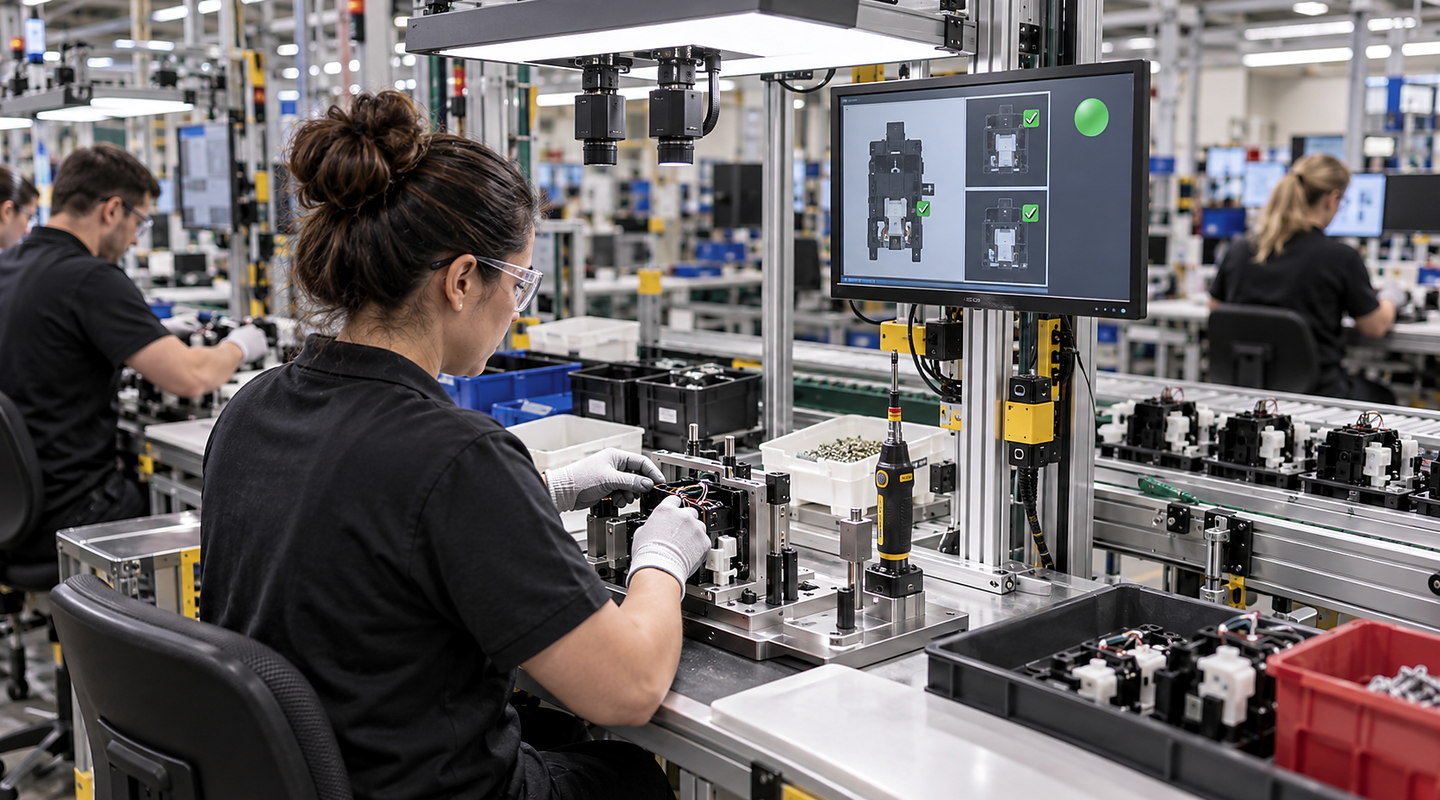
Plan missing-component inspection around a defined component list, visible verification features, representative complete and incomplete assemblies, stable presentation, reject handling and agreed challenge evidence. A useful shortlist should show how every option copes with required components and visible verification features and recipe, variant, reject and line-control interfaces.
Discuss your application

Choose a presence check that cannot confuse an empty location with a correct variant
A missing-component system needs a rule for every required location, not just a similarity score for the complete assembly. The most useful starting point is a variant-by-component matrix showing required parts, optional parts and positions deliberately left empty.
Choose a positive visible indicator
For each component, identify what the image must actually show: a head, edge, opening, colour patch or other distinctive feature. A shadow or an unrelated neighbouring part is a weaker proxy that needs separate justification. If the proof feature is hidden after assembly, compare an earlier check with an additional view rather than relaxing the acceptance rule.
Challenge missing, wrong and misplaced parts separately
Remove each required component individually and also test the wrong part in the correct location. Include an incomplete seating condition where it can be observed. These challenges answer different questions: presence does not automatically prove identity, engagement or function. Record which conclusion the proposed tool can demonstrate for each feature.
Compare fixtures as part of the optical concept
A dedicated nest may provide consistent presentation but add changeover and handling work. Conveyor inspection may reduce loading steps while allowing more movement. Trial the permitted rotation and height range, including the least favourable component location. Judge the complete inspection and handling sequence rather than only a carefully positioned reference image.
Make variant confirmation independent of appearance where required
Decide how the intended variant is supplied and checked. An assembly that resembles another variant should not silently select the wrong set of required components. Keep the recipe, assembly identity and final hold/release decision connected. Record the required views and unresolved checks in the presence-inspection specification.
Pause before choosing when…
- Only perfect complete assemblies are available for the optical trial.
- Missing, misplaced, marginal or occluded examples have not been defined.
- Normal presentation, datum and appearance variation are not represented.
- Variant recipes, rejection and recovery are still unclear.
- A visible presence result is being treated as proof of hidden or functional quality.