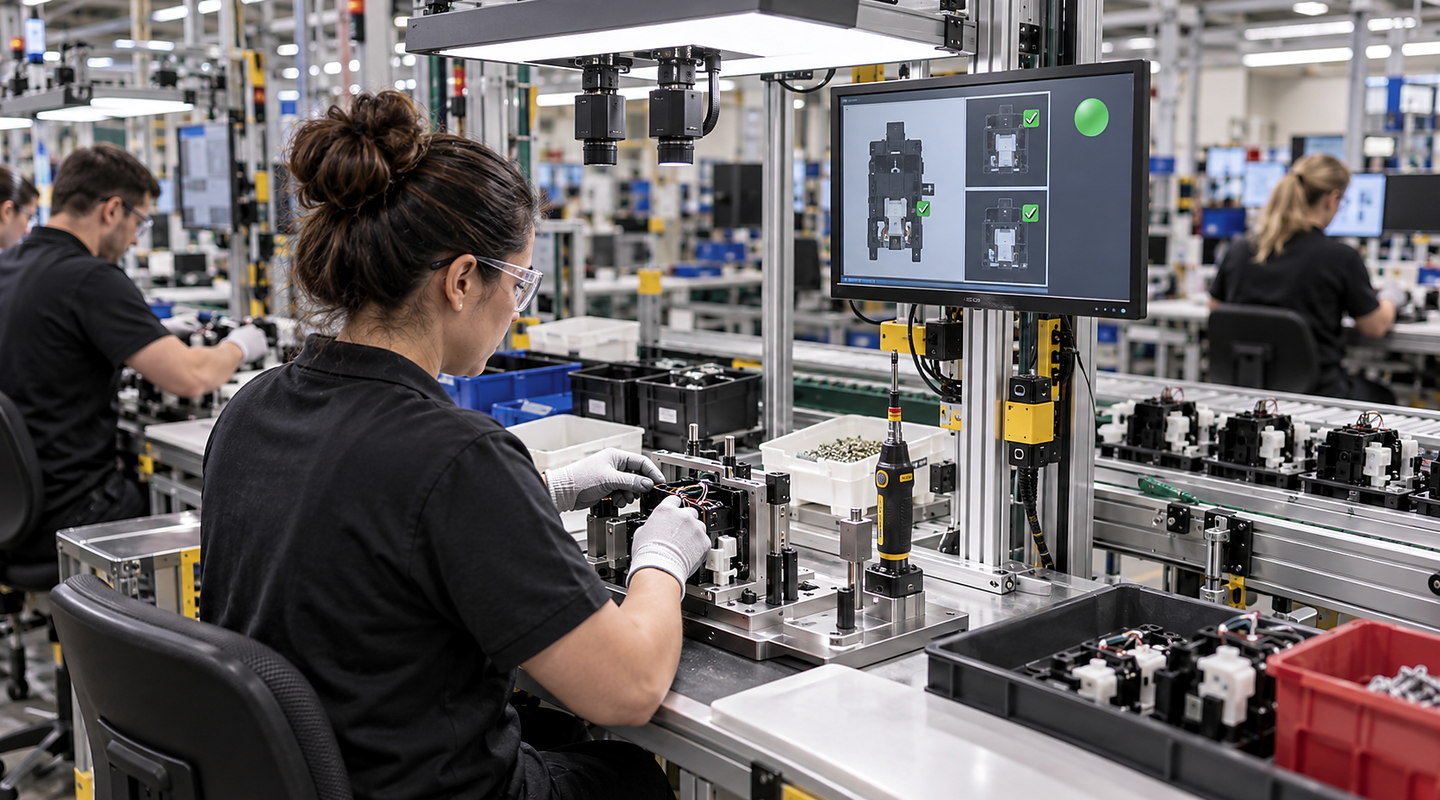
Missing Component Inspection: How the Process Works
Follow the operating sequence for missing component inspection, from preparing the input and controlling the main task to handling exceptions and checking results.
Missing Component Inspection should be considered as part of a complete production sequence: inputs are prepared, the main task is controlled, exceptions are handled and results are checked.
For your application, the important details include required components and visible verification features, complete, missing, misplaced and marginal sample range, assembly presentation, datum stability and production speed, and camera view, lighting, occlusion and environmental conditions.
Understand the complete route from input to accepted output — Missing Component Inspection
Plan missing-component inspection around a defined component list, visible verification features, representative complete and incomplete assemblies, stable presentation, reject handling and agreed challenge evidence. Follow the material or part through each operating step and include recovery, cleaning and change in the real cycle.
Discuss your application

Four clear stages for missing component inspection
At each stage, you can review how required components and visible verification features and false-accept, false-reject and challenge criteria affect the next commitment.
- 01
Define Every Required Component and Its Visible Decision Feature
Share representative good, bad and marginal samples, including the normal range for required components and visible verification features and the difficult complete, missing, misplaced and marginal sample range cases.
- 02
Collect Complete, Missing, Misplaced and Marginal Assemblies
Compare suitable methods and use focused trials to show how each option performs against assembly presentation, datum stability and production speed.
- 03
Prove Camera View, Lighting, Presentation and Timing in an Optical Trial
Connect the equipment to your line, services and controls while resolving camera view, lighting, occlusion and environmental conditions for day-to-day operation.
- 04
Challenge Variants and Faults and Retain Agreed Acceptance Results
Confirm recipe, variant, reject and line-control interfaces, then complete and record false-accept, false-reject and challenge criteria before your operating team takes over.
Decisions and results stay connected
| Stage | What happens | What you can review |
|---|---|---|
| Define Every Required Component and Its Visible Decision Feature | Confirm the requirements for presence verification of required assembly components, the operating range and the definition of a good result. | Your samples, current information and any points that still need confirming. |
| Collect Complete, Missing, Misplaced and Marginal Assemblies | Compare workable methods using required components and visible verification features and complete, missing, misplaced and marginal sample range from your real production. | The trial method, observations and reason for the recommended route. |
| Prove Camera View, Lighting, Presentation and Timing in an Optical Trial | Resolve assembly presentation, datum stability and production speed, camera view, lighting, occlusion and environmental conditions and the physical, control, safety and data connections. | The agreed layout, line connections and any changes from the proposal. |
| Challenge Variants and Faults and Retain Agreed Acceptance Results | Check normal, difficult and fault conditions before your team takes over the system. | Results for recipe, variant, reject and line-control interfaces and false-accept, false-reject and challenge criteria, plus actions and operating information. |
Keep connected responsibilities clear
Your final missing component inspection scope must also account for recipe, variant, reject and line-control interfaces, false-accept, false-reject and challenge criteria, current regulations and the conditions at your site.
- A camera can only verify a component when a reliable feature is visible.
- Occlusion, datum shift and normal appearance variation can hide or mimic a missing component.
- A visible presence result does not prove hidden bond, electrical or mechanical function.